Football is Mathematics


 Previews
 Trends
Top Trends
Trends
Top Trends
 Livescore
 Injured players
 Team Comparison
 Language


- PreviewsInsightBefore the roundFantasyOpinionMatch reportRound Overview
- LIVE predictions 4ALL predictions 3191TOP predictionsValues 477Favourites
- United Kingdom 169
- Top Europe 63
- All Europe 740
- America 212
- Africa 97
- Asia 139
 UEFA Champions League
  UEFA Europa League
  UEFA Europa Conference League
  Premier League 10
 LaLiga 10
 Bundesliga 9
 Serie A 10
 Ligue 1 9
 Eredivisie 9
 Liga Portugal 9
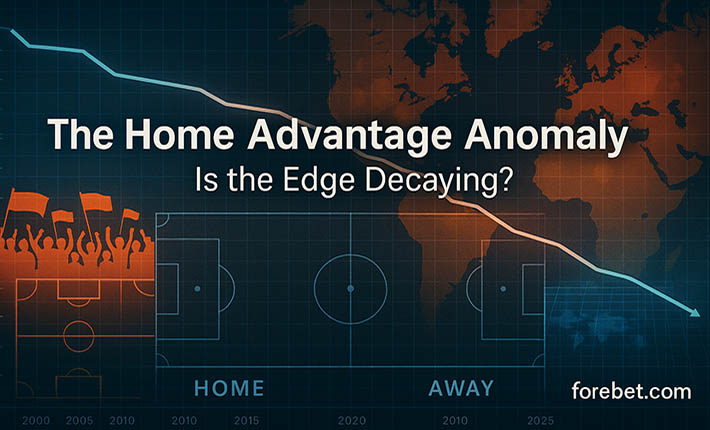
The Home Field Advantage Anomaly: Is the Edge Decaying?
 11/12/2025
1175
11/12/2025
1175
In football, as in most other sports, playing at home has a clear advantage that is born out in statistics. Home field advantage is based on factors, such as familiarity with the home field, mental assistance from the home crowd, referees being influenced by the roar of the crowd, the travel and logistics hassle the visitors go through, climate factors, such as higher elevation or hot weather, and even corruption.
However, statisticians have noticed that the home field advantage is actually decaying over time, especially in certain leagues and regions. Many see this as an anomaly, but there has been a slow decay in the home field advantage ever since the 1880s. And the reason behind it can be found through a careful analysis of the factors behind the home field advantage.
So, whether you’re looking for some extra insight on how to factor the home field advantage into your sports predictions or you’re just curious to learn more about sports - let’s find out why people are winning less and less at home.
The Home Advantage Anomaly: Historical Context and Statistical Erosion
The concept of Home Field Advantage in professional football is one of the sport's longest-standing statistical certainties, traditionally defined as the measurable benefit a team gains when competing in its own venue. Historically, this advantage was robust, reflecting fundamental assumptions about crowd influence, travel logistics, and territoriality.
However, quantitative analysis over the past two decades confirms that this edge is undergoing a systemic erosion, transforming from a constant statistical offset into a conditional variable.
Defining and Quantifying Traditional Home Advantage
Home Advantage is most commonly quantified as the percentage of competition points won by the home team out of all points gained in a league. In many established leagues, historical benchmarks for this metric ranged consistently between 60% and 68%.
Analysis of long-term trends in UEFA leagues confirms a clear pattern of decay. For instance, studies tracking the evolution of home field advantage in European leagues observed a measurable decrease exceeding two percentage points in the decade between 2000 and 2010 alone.
A macro-historical perspective reveals that this decay is a sustained trend, not a recent aberration. An examination of the English League between 1888 and 1984 showed a 4% points decline in home field advantage, falling from 67.9% to 63.9%. This established a constant downward trajectory, which has accelerated post-2000.
More recent analyses place the average home field advantage percentage across several competitive European leagues at approximately 58.25% (plus/minus 2.95%) of total accumulated points, a figure demonstrably lower than the historical mean. This divergence provides the necessary empirical foundation to conclude that the statistical edge of playing at home is genuinely eroding.
This became especially noticeable in the post-COVID, but when we compare the Premier League’s ~67.9% home field advantage in 1888 to its ~56% post-COVID baseline, we can see that the fall throughout that century and a half is of almost 10%.
Deconstructing the Edge: Performance Metrics and Referee Bias
To understand the decay of the home field advantage, it is essential to deconstruct what it actually influences. Analysis shows that the advantage is primarily leveraged in offense and discipline, meaning the decay is characterized by the neutralization of non-physical, external benefits.
The Shifting Profile of Home Field Advantage
Playing at home significantly amplifies a team’s offensive output. Data gathered from the top five European leagues (La Liga, Bundesliga, Serie A, Premier League, and Ligue 1) over eight seasons confirms that home matches yield statistically significant higher metrics for Goals, Assists, and Key Passes.
This offensive uplift is not limited to forwards. Positional analysis reveals that goals, assists, and key passes are significantly higher at home for forwards, midfielders, and even defenders. The primary function of the home environment is thus identified as facilitating offensive creativity and execution, likely through the positive psychological effects of "social facilitation," where crowd support increases perceived effort and reduces cognitive pressure on offensive actions.
Conversely, defensive performance metrics show less susceptibility to the home environment. Interceptions and fouls generally show no significant statistical difference between home and away games. While tackles might be higher away, defenders generally commit fewer fouls when playing at home.
The current decay trajectory suggests that away teams have significantly improved their psychological stability in hostile environments, mitigating the negative social pressure and consequently weakening the traditional offensive acceleration mechanism of the home field advantage.
A crucial component of the traditional home field advantage has long been attributed to the non-conscious bias of match officials. Studies have documented how the sheer presence and intensity of a partisan crowd influence referees, often resulting in favorable disciplinary and situational decisions (e.g., timing of whistles, duration of added time) for the home side, particularly at high-leverage moments.
The controlled environment created by the COVID-19 pandemic and the "ghost games" played without spectators offered an unprecedented opportunity to isolate and measure the crowd's effect on officiating. The evidence overwhelmingly demonstrated that the absence of spectators led to a "strongly reduced" home field advantage. More critically, researchers found that the systemic referee bias disappeared, providing a compelling explanation for the overall reduction in HA.
During these spectator-free periods, referees became objectively fairer, a development highlighted by the observation that the number of penalties awarded against home teams statistically approached the expected $50\%$ distribution. Across leagues, referees called more fouls against home teams and issued more yellow cards to them when fans were absent, demonstrating a removal of psychological pressure that previously favored the home side. For the major European leagues sampled, the overall proportion of yellow cards given to the home team increased significantly during the closed-door period.
The Significant Negative Effect of Team Ability
An interesting, counter-intuitive pattern emerges when controlling for team quality: advanced statistical modeling indicates that inherent team ability has a significant negative effect on the magnitude of home advantage. Quantitatively, models demonstrate that for every one-unit increase in team ability, there is an associated reduction of approximately 0.12% in the effectiveness of the home field advantage.
This correlation implies that home field advantage functions, in part, as an equalizer for less dominant sides. Teams holding lower league rankings tend to retain a measurably higher home field advantage.
This statistical relationship suggests that elite, high-ability clubs rely fundamentally less on the volatile psychological and external factors (like crowd support or referee bias) that constitute the bulk of home field advantage percentages, instead depending on their intrinsic technical and tactical superiority.
The structural decay of the home field advantage observed across top leagues, therefore, disproportionately impacts the relative performance of elite clubs, which have less of a "home advantage cushion" to begin with.
A World Divided: Varying Decay Rates by Region and Continent
The analysis of the home advantage decay in Europe, driven largely by the removal of fans and referee bias, stands in sharp contrast to regions where the home edge remains powerful and persistent. A global survey of domestic leagues indicates that home field advantage is present across all continents, but its magnitude varies dramatically, often dictated by physical, environmental, and structural barriers that modernization has yet to overcome.
Regions with Persistent or Extreme Home Advantage
While European home advantage has moderated to the 56%-59% range, certain global regions exhibit an extreme home advantage magnitude.
A comparative analysis of Forebet’s match data from 157 major national leagues between 2006 and 2012 identified pockets where the home team won between 70% and 80% of all points. This includes the top leagues of Bosnia-Herzegovina, Guatemala, Algeria, Bolivia, and Ghana.
Notably, Nigeria registered an extremely high home field advantage of 86.82%. Similarly high percentages were found throughout Eastern Asia and South America too, indicating that the phenomenon is robust outside the highly standardized European territory. These persistent figures demonstrate that the decline observed in Western Europe is not a universal trend.
What Determines a High Home Field Advantage?
The resilience of the home field advantage in these non-Western European regions is directly linked to factors that are highly resistant to tactical mitigation or officiating reform. These dominant causal factors shift the nature of the advantage from psychological to physiological and logistical.
Altitude and Climate Acclimation: High home field advantage is strongly correlated with two environmental variables. First, leagues with teams playing at high altitudes, such as those in the Andes or specific regions of Central America, report high home field advantages because visiting teams struggle physiologically with oxygen deprivation.
Second, extreme weather conditions, including high heat and humidity, in regions like Saudi Arabia and India, bestow a clear advantage upon local teams that are acclimated to the climate, while visiting teams suffer fatigue and reduced performance.
These factors are especially true for international competitions.
Travel and Logistics: Geographical scale exacerbates the home field advantage. The maximum geographical distance between teams within a league is a significant predictor of a domestic advantage, as vast distances lead to severe travel fatigue for visiting teams, particularly prevalent in large continental leagues across Asia and South America.
While professional leagues in Europe and North America have benefited from optimized and faster travel schedules, mitigating this factor, the logistical strain remains a dominant, undecaying mechanism in less centralized regions.
Governance and Systemic Factors: Beyond geography and climate, systemic factors related to league management and local jurisdiction are highly predictive. Statistical modeling has found that the Corruption Perception Index is a significant covariate of the home field advantage’s magnitude.
This suggests that where structural governance is weaker, the potential for systemic biases, consciously or unconsciously enforced, strengthens the home team’s statistical likelihood of winning, creating an additional layer of decay resistance.
What Does This Mean for You and How You Use Forebet’s Predictions?
The advantage of playing on your own turf is certainly still a major factor, including in Western Europe and Forebet’s algorithm is factoring it into its predictions.
However, the above analysis indicates not only that the home field advantage is decaying over time, as leagues develop and teams improve their performances. It also indicates that the home turf advantage in every match should be treated individually when making your predictions, whether you base them on Forebet’s stats or not.
How much did the away team have to travel to the venue? Is referee corruption an issue in that particular league? Is the league using a Video Assistant Referee (VAR) to help mitigate the crowd’s effect on referees? Is the away team robust and disciplined enough to have a good Away form? Is the climate/weather/altitude going to be too different to what the away team is used to?
After all, there is a reason why they say a player’s ability can’t be judged properly until they play “on a rainy night in Stoke.”
Premier League
<>September 2026Football predictions{"8":"August 2026","9":"September 2026","10":"October 2026"}Mon Tue Wed Thu Fri Sat Sun 01 02 03 04 05 06 07 08 09 10 11 12 13 14 15 16 17 18 19 20 21 22 23 24 25 26 27 28 29 30 OVERALL TABLE OVERALL TABLE PTS GP W D L +/- 1Manchester City 15 5 5 0 0 8 2Arsenal 12 5 4 0 1 4 3Brighton 10 5 3 1 1 11 4Brentford 9 5 2 3 0 6 5Leeds United 9 5 2 3 0 4 6Liverpool 9 5 2 3 0 3 7Everton 9 5 2 3 0 3 8Hull City 8 5 2 2 1 2 9Newcastle United 8 5 2 2 1 0 10Chelsea 7 5 2 1 2 -2 11Ipswich Town 6 5 2 0 3 -4 12Manchester United 5 5 1 2 2 0 13Nottingham Forest 5 5 1 2 2 -1 14Sunderland 4 5 1 1 3 -4 15Crystal Palace 4 5 1 1 3 -5 16Aston Villa 4 5 1 1 3 -5 17Bournemouth 3 5 0 3 2 -2 18Coventry City 3 5 1 0 4 -9 19Fulham 2 5 0 2 3 -3 20Tottenham 2 5 0 2 3 -6 Champions LeagueEuropa LeagueRelegationPick of the day
14th3rdNew England Revolution have seen both teams score in each of their last 6 Major League Soccer matches.
Top trends
 Cruz AzulUnbeaten 45 of 53
In their last 53 games in Liga MX, Cruz Azul have been undefeated on 45 occasions
 SpainUndefeated 39
Spain haven't lost any of their last 39 matches in all competitions
 Barcelona WWon 25
Barcelona W have won their last 25 Primera Division Women games in a row
 RotherhamWinless 3 of 20
Rotherham's form hasn't been good, as the team has won only 3 of their last 20 matches (all competitions)
 Malta U21Lost 19
Malta U21 are on a losing streak of 19 straight matches in Euro U21 Qualification
 Brown de AdroguéUnder 2.5 goals 15
There have been under 2.5 goals in 15 of the latest games in Primera B Metropolitana of Brown de Adrogué
 FK KarlskronaWon by 2+ goals 11
Their last 11 games in the Division 2 - Södra Götaland have seen FK Karlskrona win by 2 or more goals
 Central BallesterClean sheets 7
Central Ballester have kept a clean sheet in all of their last 7 league matches
 KazakhstanScored None 7
No goals have been scored by Kazakhstan in their last 7 games in UEFA Nations League
 San MarinoLost by 3+ goals 5
San Marino have suffered losses by 3 or more goals in all 5 of their latest games in all competitions


ABOUT
Football is mathematics. Forebet is a free data and analytics platform for football and sports predictions. It utilizes mathematical algorithms and statistical models to process historical match data across more than 850 football leagues and other major sports competitions worldwide. Since 2009, Forebet has leveraged the power of mathematical algorithms and statistical models to transform raw data into actionable intelligence, match analytics, and data-driven sports predictions for fans worldwide. The platform is designed to support informed decision-making by presenting objective probabilities and structured football and sports statistics.PREDICTIONS
MORE
Copyright © 2009-2026 Forebet.com All rights reserved.